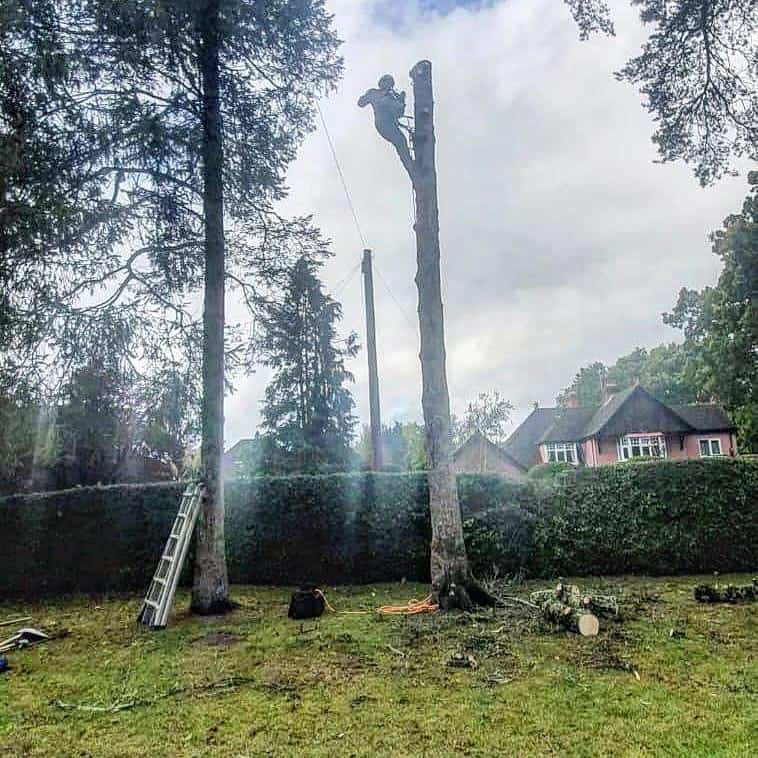
Tree felling requires careful planning to ensure that a tree can be removed in a controlled manner without causing unnecessary damage to its surroundings. While some trees can be felled in a single direction and brought down in one piece, others need to be dismantled gradually using specialist climbing and lowering techniques.
The most suitable method depends on several factors, including the tree’s size, condition, natural lean and the amount of available space. For property owners on Hayling Island, Hampshire, understanding these considerations helps explain why a professional assessment is essential before tree removal begins.
The Amount of Available Space Around the Tree
One of the most important factors is whether there is enough clear ground for the entire tree to fall safely. A tree may appear to have sufficient space from one angle, but nearby buildings, fences, garden structures, driveways and neighbouring trees can restrict the available landing area.
A professional tree surgeon will assess the tree’s height and overall spread against the space available. If the tree cannot be brought down without contacting surrounding obstacles, felling it in one piece may not be suitable.
In more confined gardens, sectional dismantling is often the better approach. This involves removing branches and sections of the trunk gradually, allowing the work to be controlled throughout the process.
Tree Height and Trunk Diameter
The overall dimensions of a tree have a significant influence on the felling method. Taller trees require a larger clear area, while a wide or heavy trunk can create additional challenges when planning how the tree will fall.
The tree surgeon will consider its height, trunk diameter, branch spread and overall weight. These characteristics help establish whether the tree can be felled as a single unit or whether removing it in smaller sections would provide better control.
Even where sufficient ground space is available, the tree’s size may make sectional removal more appropriate.
The Tree’s Natural Lean and Structural Condition
A tree’s natural lean affects how its weight is distributed and can influence the direction in which it is likely to move during felling. A pronounced lean towards a building, boundary or other obstacle may make a straightforward removal unsuitable.
The structural condition of the tree is equally important. Internal decay, cracks, damaged roots and weakened branch unions can affect how the tree responds when cutting begins.
A tree with compromised structural integrity may behave unpredictably. A professional assessment helps identify these concerns and determine whether controlled sectional dismantling is necessary.
Nearby Buildings and Other Obstacles
The surrounding environment must be considered before deciding on a felling method. Trees growing close to houses, garages, sheds, walls or other structures often have limited clearance.
Overhead obstacles and restricted access can also influence the work. Even if the trunk has enough room to fall, branches may extend into areas where they could cause damage.
Where obstacles prevent a clear felling direction, professional tree surgeons may need to climb the tree and remove the canopy in manageable sections. Specialist ropes and lowering equipment can help control the movement of branches and trunk sections during dismantling.
Ground Conditions and Access
The condition of the ground around a tree can affect how the work is organised. Uneven, soft or sloping ground may create additional difficulties when positioning equipment and preparing the working area.
Access is another important consideration. Tree surgeons need to establish whether suitable equipment can reach the site and whether there is enough room to handle the removal safely.
These factors are particularly relevant in established gardens where landscaping, narrow entrances or existing structures may restrict movement.
The Type of Tree and Its Branch Structure
Different tree species develop different growth habits and structural characteristics. Some have relatively straight trunks and balanced canopies, while others develop multiple stems, wide-spreading branches or irregular growth patterns.
A tree with several main stems may be more difficult to fell in one piece than one with a single, well-defined trunk. Branch arrangement and canopy density can also affect how the tree is likely to move during removal.
Understanding the species and its structure helps a professional tree surgeon select an appropriate technique rather than relying on a standard approach for every tree.
Why a Professional Tree Felling Assessment Matters
Deciding whether a tree can be felled in one piece requires more than estimating its height or checking the available space. All relevant factors must be considered together, including its condition, weight distribution, surroundings and access requirements.
LM Tree Surgery Hayling Island can assess trees and recommend a suitable removal method based on the individual circumstances. Where a straightforward felling operation is not appropriate, sectional dismantling can provide a more controlled alternative.
A thorough assessment helps ensure that the chosen method reflects the actual conditions on site and that the work is properly planned before it begins.
Conclusion
Whether a tree can be felled in one piece depends on its size, natural lean, structural condition, branch arrangement and the space available around it. Nearby buildings, ground conditions and access restrictions can also make sectional dismantling the more suitable option.
For property owners on Hayling Island, Hampshire, professional assessment is an important first step towards safe and well-planned tree removal. If you have a tree that needs attention, contact LM Tree Surgery Hayling Island to discuss its condition and the most appropriate approach.
Call us on: 023 8235 2063
Click here to find out more about LM Tree Surgery Hayling Island
Click here to complete our contact form and see how we can help with your tree needs.